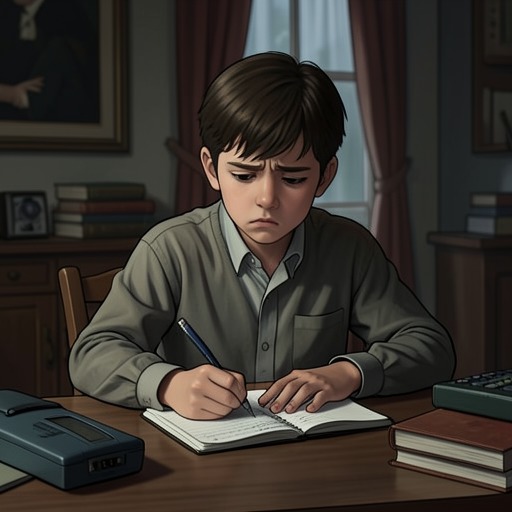
White lie
The Curious Incident of the Dog in the Night-TimeThe expression “White lie” names Christopher’s way of describing speech that is literally true in part but deliberately incomplete. It matters because his examples turn an ordinary social convention into a precise distinction between what a statement says and what it leaves unsaid—and show him using that distinction to protect his own intentions.
Definition and Logic
Christopher says that a white lie is “not a lie at all,” but a statement that tells the truth without telling all of it. He illustrates the idea with a question about what someone wants to do that day: naming one desired activity does not require listing every other thing the person also wants to do, from eating lunch to going to bed. The example makes omission, rather than a false assertion, the defining feature.
His account also reveals a tension in the expression. Although he insists that the statement is not a lie, he recognizes that a speaker can leave information out for a reason. For him, calling such speech a white lie makes that partial truth intelligible without treating it as an outright falsehood.
Concealing the Investigation
At supper, Father asks Christopher where he has been. Christopher answers that he has been out, then identifies this as a white lie: he has withheld the fact that he was investigating, because he knows Father does not want him to be a detective. His plate contains baked beans, broccoli, and two slices of ham, arranged so that the foods do not touch; as he begins eating, the question of where he has been remains unanswered in the fuller sense.
The exchange places the expression inside a conflict over Christopher’s independence. His answer is not factually false, but it is chosen to keep Father from learning what he has been doing. The label therefore distinguishes his verbal method from a direct fabrication while making clear that the omission serves a purpose.
The Shop Story
Christopher uses the same label again when Father questions how long he was away. He says that he went to the shop for licorice laces and a Milky Bar, then claims that he talked to Mrs. Alexander’s dog outside the shop, stroked him, and had the dog sniff his trousers. Christopher explicitly calls the dog story another white lie.
The recurrence shows that the expression applies to more than one kind of incomplete account: it first describes withholding the purpose of an outing and then marks a particular claim made while explaining the delay. Rhodri responds that Christopher is getting the third degree, but Christopher does not understand the idiom. The scene thus sets Christopher’s exact, self-conscious category for partial truth against a figurative expression whose meaning he cannot readily infer.